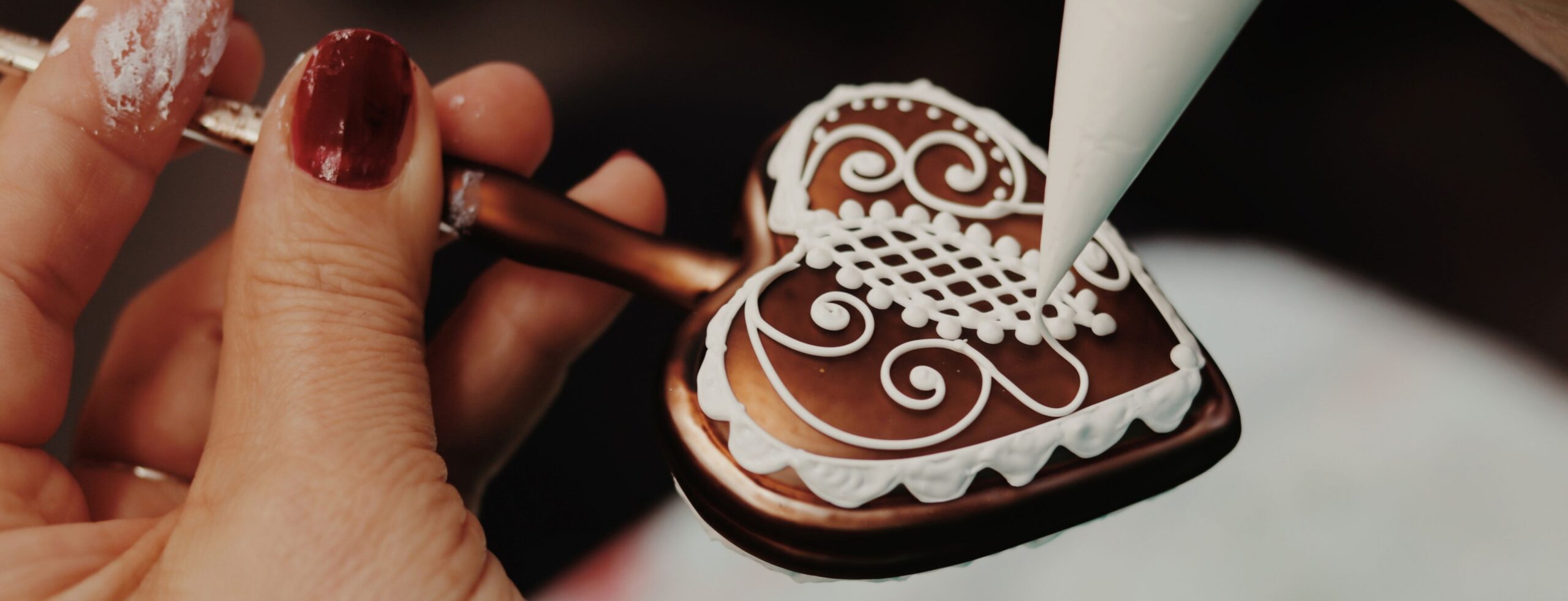
You may not know this, but our Christmas ornaments go through a lot more work than you might think.
They are made by hand in the Czech Republic, in the heart of Crystal Valley. The glass is blown and shaped by hand, then decorated. A single ornament can pass through the hands of several people before it takes on its final form.
And it’s this handwork that gives every piece its own character.
How are Decor by Glassor ornaments made?
It starts with the glass and the glassblower. The glass is blown by hand and shaped into the form it needs to take. Some ornaments are free-formed: the glassblower models the glass by hand while blowing it.
Then comes the decoration.
The vast majority of our ornaments are hand-painted, which makes it possible to create truly fine, precise strokes. Each pattern is painted separately, each ornament one at a time. So the result is never a set of perfectly identical copies.
Quite the opposite. Look closely and you can see individual brushstrokes on some of the ornaments. They’re the best proof that the decoration wasn’t printed or made by machine. Every piece has passed through human hands. You can see it clearly in our Mistletoe & Holly collection, for example.

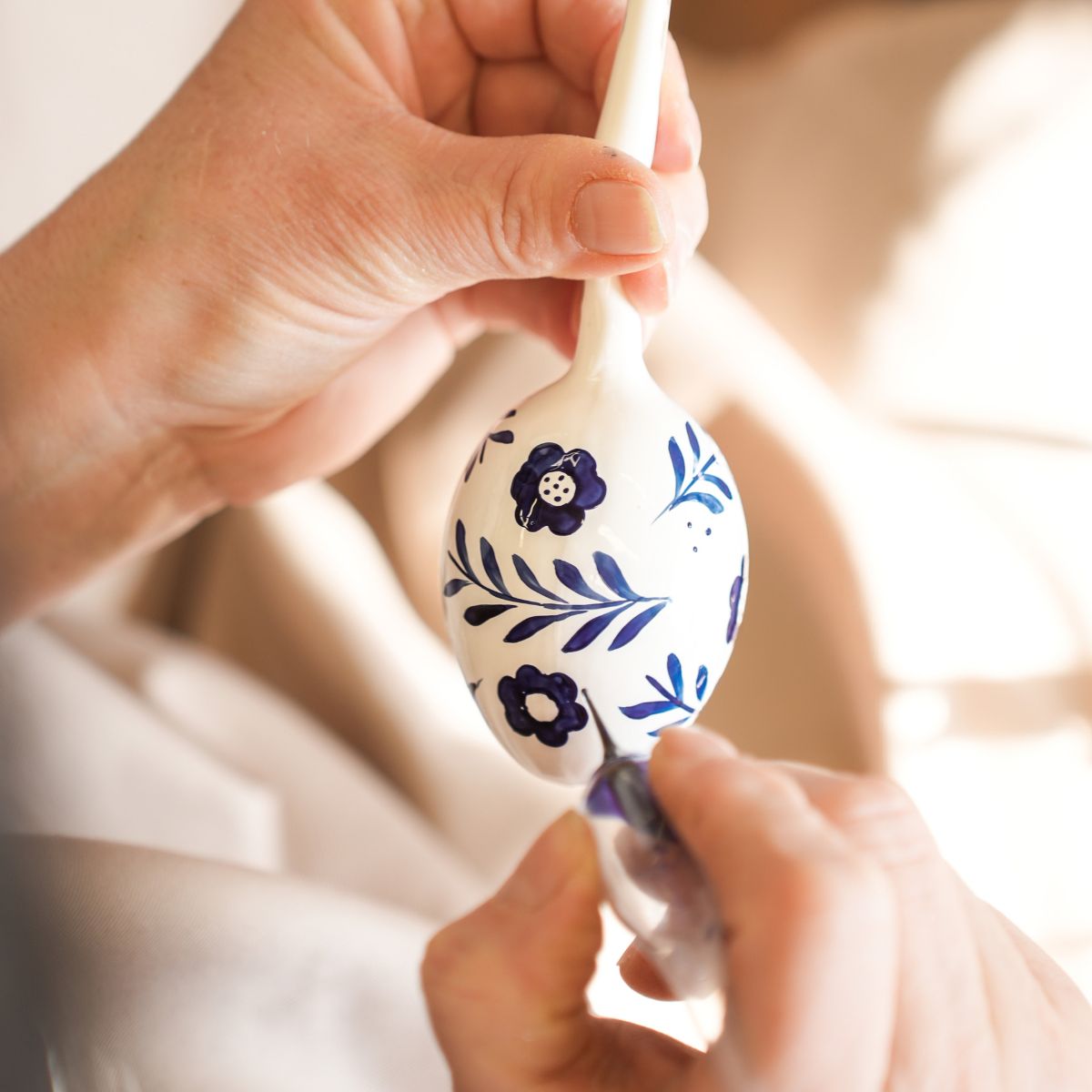
Depending on the design, we also use hand gilding, glitter and other decorating techniques. If the finished ornament is meant to be opaque, the glass is silvered on the inside.
So an ornament isn’t necessarily the work of a single person. Several people may contribute to its final look, each adding their own part.
Not just baubles
Say “handmade glass ornament” and you might picture a classic round bauble.
With us, though, glass also takes on a slightly more cheerful shape.
We make traditional Christmas baubles, but also all kinds of unconventional shapes. You’ll find a beer, a vánočka (the braided Czech Christmas loaf), all sorts of little figures, a chlebíček (the Czech open-faced sandwich) or a schnitzel. Yes, even a schnitzel can hang on a Christmas tree.
These different shapes, colours and ways of decorating let us use Czech glassmaking craft a little differently. Alongside classic Christmas motifs, we make ornaments that are bold, playful or deliberately a bit unexpected.
Whether it’s a traditional bauble or a chlebíček, an ornament always begins with glass and human hands.

Each one is a little different
This is one of the things we love most about making things by hand.
When every ornament is painted separately and every pattern is made by hand, you simply can’t produce hundreds of perfectly identical pieces. Small differences in the painting, the brushstroke or the decoration are a natural part of the whole process.
And they’re exactly what gives each piece its own character.
On one ornament a brushstroke may be a touch bolder, on another a little finer. A detail here and there will be slightly different. It isn’t a mistake, or an imperfection we’re trying to hide.
It’s the trace of handwork.
Which makes every ornament an original in its own way.
Why ornaments from Crystal Valley?
It’s no coincidence that our ornaments are made in the Czech Republic. We make them in a region that has been bound up with glass for centuries.
Crystal Valley (Křišťálové údolí in Czech) lies in the north of Bohemia. It’s a glassmaking and jewellery region, remarkable for the sheer number of crafts, techniques and people devoted to glass.
The glassmaking tradition here goes back as far as the 13th century. Today, the Crystal Valley name brings together more than 100 companies, museums and schools in the Liberec Region connected with glass and other crafts.
And it isn’t just history. The region still has glassworks, studios, workshops, schools and museums where people work with glass every day and pass their experience on.
That’s exactly why it makes sense for us to make our ornaments right here.
A place where glass has a tradition
Czech glass has had a reputation around the world for hundreds of years. In the second half of the 17th century, the Czech lands began producing a perfectly clear glass whose clarity, brilliance and hardness made it ideal for engraving and cutting.
So-called Bohemian crystal became an important Czech product, and it was in such demand that in the first half of the 18th century the Czech lands became the world’s leading exporter of glass.
Glassmaking gradually spread across different parts of northern Bohemia, and individual places developed their own specialities. Kamenický Šenov became known for crystal chandeliers, the area around Jablonec for costume jewellery, Železný Brod for glass figurines, and in Poniklá traditional glass Christmas ornaments are still made to this day.
So Crystal Valley isn’t one particular kind of production. It’s a region where, over the centuries, dozens of different glassmaking and jewellery techniques have come together.
And glass is still made here.
